
Consortium of Lichen Herbaria
- building a Global Consortium of Bryophytes and Lichens as keystones of cryptobiotic communities -
- Home
- Search
- Images
- Species Checklists
- US States: O-Z >
- US National Parks
- Central America
- South America
- US National Parks
- Southern Subpolar Region
|
Nephroma resupinatum (L.) Ach.
 |
|
|
Family: Peltigeraceae
[Lichen resupinatus L., moreNephroma resupinata (L.) Ach., Nephroma tomentosum (Hoffm.) Flot., Nephromium resupinatum (L.) Arnold, Nephromium resupinatum var. nordinii (Gyeln.) Räsänen, Nephromium resupinatum var. papillosa Räsänen, Nephromium resupinatum var. resupinatum (L.) Arnold, Nephromium tomentosum (Hoffm.) Nyl., Nephromium tomentosum var. isidiosum Nyl., Nephromium tomentosum var. tomentosum (Hoffm.) Nyl., Opisteria resupinata (L.) Vain., Ornatinephroma resupinatum (L.) Gyeln., Ornatinephroma resupinatum f. inaequale (Gyeln.) Gyeln., Ornatinephroma resupinatum f. resupinatum (L.) Gyeln., Ornatinephroma resupinatum var. helvum (A. Massal.) Gyeln., Ornatinephroma resupinatum var. resupinatum (L.) Gyeln., Parmelia tomentosa (Hoffm.) Wallr., Peltidea resupinata (L.) Ach., Peltidea resupinata var. microcarpa Clemente, Peltidea resupinata var. resupinata (L.) Ach., Peltigera tomentosa Hoffm., Sticta drummondii Taylor]  Samuel Brinker |
Nash, T.H., Ryan, B.D., Gries, C., Bungartz, F., (eds.) 2002. Lichen Flora of the Greater Sonoran Desert Region. Vol 1. Thallus: foliose, continuously forming rosettes, 3-10 cm wide, loosely adnate, lobate lobes: irregular, broad (5-17 mm wide), elongate; apices: usually subrotund, entire or crenulate, sometimes ascending upper surface: gray to grayish brown, dull, usually strongly pubescent; isidia and soredia absent.but frequently with regeneration squamules marginally or along cracks medulla: white photobiont: the cyanobacterium Nostoc lower surface: pale brown to yellow-brown or whitish, densely tomentose, white papillate (scarcely to densely) Apothecia: common, on lower surface at tips of lobes, orbicular, up to 15 mm diam., cup-shaped, sessile; dorsal surface: tomentose, coarsely scabrid and foveolate-reticulate; margin: prominent with thalloid rim; disc: dark brown; exciple: hyaline or light brown, 20-30 µm thick; epithecium: brown or brownish yellow; hypothecium: hyaline asci: 8-spored ascospores: fusiform, 3-septate, 21-24 x 4-6 µm; wall: thin, light brown Pycnidia: marginal, immersed, punctiform, 0.15-0.20 mm diam. conidia: rod-shaped, 4-5 x 1-2 µm Spot tests: upper surface: K-, C-, KC-, P-; medulla K-, C-, KC-, P- Secondary metabolites: none detected. Habitat and ecology: on acidic rocks among mosses and tree trunks in moist canyons at mid- to high elevations, most common in spruce-fir regions World distribution: South Pacific and Northern Hemisphere, where it occurs in boreal and north temperate regions and extends south along the west coasts in maritime influenced regions Sonoran distribution: central and eastern Arizona. |
 Troy McMullin  Troy McMullin  Stephen Sharnoff  Stephen Sharnoff  Stephen Sharnoff 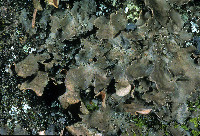 Stephen Sharnoff  Stephen Sharnoff  Stephen Sharnoff  Stephen Sharnoff  Stephen Sharnoff  Stephen Sharnoff  Lucy Taylor                            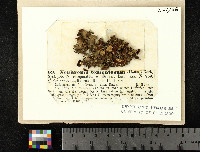                   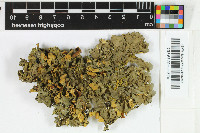            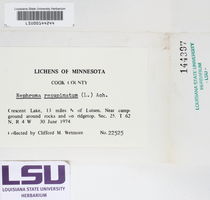                      |
|


Powered by Symbiota