
- Home
- Search
- Images
- Species Checklists
- US States: O-Z >
- US National Parks
- Central America
- South America
- US National Parks
- Southern Subpolar Region
|
Lecanora achroa Nyl.
 |
|
|
Family: Lecanoraceae
 Nora Wirtz |
MycoBank no. 387537 Type: Mauritius. Rodriguez Island: exact locality unknown, Sep–Dec 1874, Balfour, J.B. s.n. [H-Nyl 27475–lectotype, designated by Guderley (1999)]. Description. Thallus corticolous, thin to moderately thickened, areolate to granular areolate, developing initially from isolated areoles on a whitish arachnoid hypothallus, areoles becoming contiguous with age; surface white to pale gray or pale greenish gray, smooth to slightly dull and ±verruculose, matt, epruinose, lacking soredia; prothallus well developed, Chemistry. Thallus cortex including thalline margin K+ yellow, C–, KC–, PD+ orange yellow, UV– (dull); Galapagos specimens contain atranorin [major], ±usnic acid [major], ±2’-O-methylperlatolic acid [major], and zeorin Ecology and distribution. Pantropical (North, Central and South America, Indian Ocean, Australia, South Pacific), new to Ecuador and the Galapagos; an infrequent corticolous species in the dry zone (but difficult to differentiate from L. leprosa and thus possibly more common than the few cited specimens might suggest). Notes. Guderley (1999) apparently confused Galapagos records of Lecanora achroa and L. leprosa with the very similar L. helva, when he reported that the Galapagos endemic, L. schindleri, is often associated with L. helva (Guderley 1999, p. 227). His distribution maps, however, only show L. leprosa (fig. 9C p. 165) and no Galapagos specimens of L. achroa or L. helva are cited (Guderley 1999, p. 176: specimens of L. achroa, and p. 207: L. helva). All three species, L. achroa, L. helva and L. leprosa are morphologically and anatomically extremely similar, but differ in their chemistry. Lecanora leprosa is easily distinguished by the presence of gangaleoidin, but reports as to which secondary metabolites are most characteristic for L. achroa vs. L. helva are not in agreement. According to Guderley (1999) L. achroa is characterized by usnic acid, ±atranorin, chloroatranorin, ±zeorin and other terpenes. Lumbsch & Elix (2004) and Ryan et al. (2004) report that accessory 2’-O-methylperlatolic acid may also be present, but according to Guderley (1999) this compound only occurs in L. helva. For L. helva Guderley (1999) reports the occasional presence of arthothelin, but Lumbsch & Elix (2004) and Ryan et al. (2004) consider this to be the major secondary metabolite characteristic of L. helva. Arthothelin has not been found in any Galapagos specimen and the presence of usnic and 2’-O-methylperlatolic acid best agrees with the chemistry that Lumbsch & Elix (2004) and Ryan et al. (2004) report for L. achroa. We therefore consider previous reports of L. helva erroneous and instead here now report L. achroa. Nash, T.H., Ryan, B.D., Gries, C., Bungartz, F., (eds.) 2004. Lichen Flora of the Greater Sonoran Desert Region. Vol 2. Thallus: crustose, continuous or rimose-areolate; prothallus: blackish to bluish brown areoles: flat, thin, opaque, ecorticate surface: yellowish white to yellowish gray or yellowish green or pale green to greenish white, smooth, epruinose, with an indistinct margin, esorediate Apothecia: sessile, 0.3-0.9 mm in diam., lecanorine disc: orange-brown or yellowish brown, plane or convex, epruinose or slightly whitish gray pruinose margin: concolorous with thallus, thin or thick, persistent or becoming excluded, even, not flexuose, smooth, entire or verruculose, without a parathecial ring amphithecium: present, with numerous algal cells, with large crystals insoluble in K, corticate; cortex: distinct, basally not thickened, interspersed with numerous small crystals, hyaline, (15-)25-35(-40) µm thick laterally, (15-)25-35(-40) µm thick basally parathecium: hyaline, containing small crystals insoluble in K epihymenium: yellowish brown to orange-brown, with pigment dissolving in K, with crystals dissolving in K hymenium: hyaline, clear; paraphyses: sparingly branched and slightly thickened (up to 2.5 µm wide) apically, not pigmented; subhymenium: hyaline, 15-20 µm thick; hypothecium: hyaline, without oil droplets asci: clavate, 8-spored ascospores: hyaline, simple, ellipsoid or broadly ellipsoid, 10.5-16.5 x 6.5-8.5 µm; wall: less than 1 µm thick Pycnidia: not observed Spot tests: K+ yellow, C- or C+ orange, P+ pale yellow Secondary metabolites: arthothelin (minor or absent), atranorin (submajor), chloroatranorin (minor), 2'-O-methylperlatolic acid (major), usnic acid (major) and traces of unidentified terpenes. Substrate and ecology: on the bark of deciduous trees World distribution: pantropical occurring in North, Central and South America, Indian Ocean islands, Australia, north island of New Zealand, Papua New Guinea and the South Pacific Sonoran distribution: Baja California Sur and Sinaloa. Notes: Lecanora achroa is characterized by the comparatively small apothecia with orange-brown disc, the small ascospores, and the presence of usnic acid. It is similar to L. helva and L. leprosa, but readily distinguished by the different chemistry. |
 Frank Bungartz  Frank Bungartz  Nora Wirtz  Kim Rice : Field Museum of Natural History - Botany Department  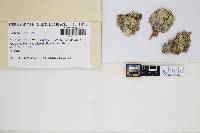 Kim Rice : Field Museum of Natural History - Botany Department    |
|


