
Consortium of Lichen Herbaria
- building a Global Consortium of Bryophytes and Lichens as keystones of cryptobiotic communities -
- Home
- Search
- Images
- Species Checklists
- US States: O-Z >
- US National Parks
- Central America
- South America
- US National Parks
- Southern Subpolar Region
|
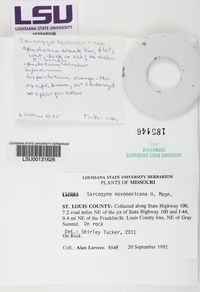
Sarcogyne novomexicana H. Magn.
 |
|
|
Family: Acarosporaceae
 |
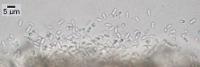
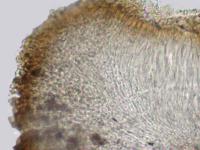
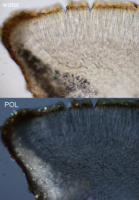
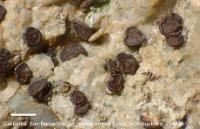
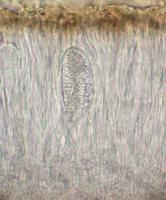
Nash, T.H., Ryan, B.D., Gries, C., Bungartz, F., (eds.) 2007. Lichen Flora of the Greater Sonoran Desert Region. Vol 3. Thallus: endolithic, without algae beneath the apothecia Apothecia: round to lobed, 0.8-1.8(-2.2) mm across, broadly attached but becoming stipitate, c. 0.3 mm thick, commonly divided to form lobe-like in clusters disc: brownish orange or somewhat red (reddish orange to orange when wet), smooth, plane to somewhat convex, dull, epruinose margin: same color or darker than disc true exciple: overall 100-130(-150) µm thick, externally dark brown, internally hyaline, laterally brownish golden, extending underneath to the attachment, with easily discernible apices of hyphae 5-7.5 µm in diam. epihymenium: orange-red in thick section yellowish gold in thin section, 15-20 µm thick hymenium: orange in thick section, hyaline to yellow-gold in thin section, 85-105 µm tall; paraphyses: conglutinate to loose, basally 2-3.1(-3.5) µm wide, apically (2-)3.5-4.5 µm wide, often with black hoods subhymenium: yellow, c. 20 µm thick hypothecium: yellow, 10-35 µm thick asci: clavate, 60-70 x 17-20 µm, 100+-spored ascospores: hyaline, simple, broadly ellipsoid, (4.6-)5-6 x 2.5-3.1 µm Pycnidia: not observed Spot tests: all negative Secondary metabolites: none detected. Substrate and ecology: on acidic and carbonaceous rock World distribution: southwestern United States (California and New Mexico) Sonoran distribution: occasionally in southern California above 1500 meters. Note: A neotype was recently selected (Knudsen and Lendemer 2005a) and deposited at UPS. It is especially common on carbonaceous rock in San Bernardino Mountains along the edge of the Mojave Desert. |




Powered by Symbiota