
Consortium of Lichen Herbaria
- building a Global Consortium of Bryophytes and Lichens as keystones of cryptobiotic communities -
- Home
- Search
- Images
- Species Checklists
- US States: O-Z >
- US National Parks
- Central America
- South America
- US National Parks
- Southern Subpolar Region
|
Thelenella modesta (Nyl.) Nyl.
 |
|
|
Family: Thelenellaceae
[Luykenia modesta (Nyl.) Trevis., moreMicroglaena modesta (Nyl.) A.L. Sm., Microglaena modesta f. modesta (Nyl.) A.L. Sm., Microglaena modesta f. septentrionalis (Th. Fr.) H. Magn., Microglaena modesta var. carneofusca Makar., Microglaena modesta var. modesta (Nyl.) A.L. Sm., Microglaena subcorallina Hasse, Polyblastia modesta (Nyl.) H. Olivier, Verrucaria modesta Nyl.]  |
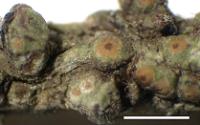
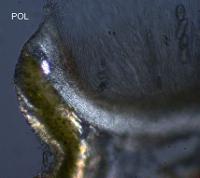
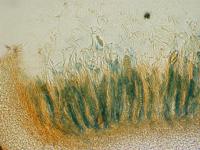
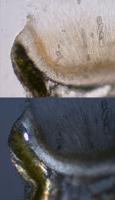
Nash, T.H., Ryan, B.D., Gries, C., Bungartz, F., (eds.) 2002. Lichen Flora of the Greater Sonoran Desert Region. Vol 1. Thallus: thin to thick, superficial, membranous, rimose to deeply cracked-areolate upper surface: yellow-gray to pink or red-brown, fading to pale gray or gray in the herbarium; smooth to uneven-warted prothallus: absent Perithecia: dispersed; ostiole dark-brown; involucrellum: absent; exciple: colorless below, brownish above; hamathecium: composed of persistent paraphyses, richly branched and anastomosed; periphysoids towards the inner side of the ostiole; periphyses absent asci: cylindrical, 4- to 8-spored ascospores: colorless, rarely becoming pale yellow-brown when overmature, muriform, with 7-9 lateral and 2-3 longitudinal septa, ellipsoid to narrowly ellipsoid, 25-42 x 11-17 µm Pycnidia: immersed conidia: filiform, colorless, 11-14 x 0.6-0.8 µm Spot tests: all negative Secondary metabolites: none detected. Substrate and ecology: bark (on smooth bark of Quercus agrifolia and Juglans californica in southern California) World distribution: temperate and mediterranean Europe, mediterranean northern Africa, North America and Australia Sonoran distribution: San Gabriel Mountains and the Santa Monica Range in southern California. Notes: This species is characterized by its rimose to deeply cracked-areolate, yellow-gray to pink or red-brown thallus and muriform colorless ascospores. Thelenella hassei is distinguished by its brown ascospores. |








Powered by Symbiota