
Consortium of Lichen Herbaria
- building a Global Consortium of Bryophytes and Lichens as keystones of cryptobiotic communities -
- Home
- Search
- Images
- Species Checklists
- US States: O-Z >
- US National Parks
- Central America
- South America
- US National Parks
- Southern Subpolar Region
|
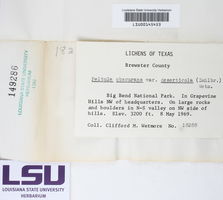
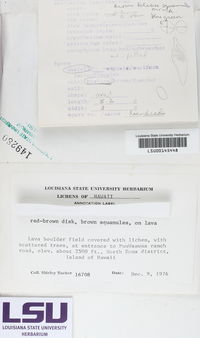
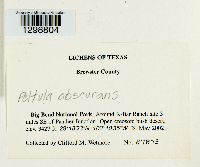
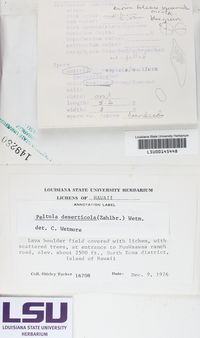
Peltula obscurans var. deserticola (Zahlbr.) Wetmore
 |
|
|
Family: Peltulaceae
[Heppia deserticola Zahlbr.]  |
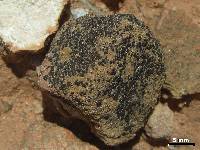
Nash, T.H., Ryan, B.D., Gries, C., Bungartz, F., (eds.) 2002. Lichen Flora of the Greater Sonoran Desert Region. Vol 1. Thallus: squamulose, usually widely scattered squamules: orbicular, not lobed, flat to convex at top, 0.5-1.2 mm diam. upper surface: olive-brown, not sorediate upper cortex: not developed but with a yellowish epinecral layer medulla: partly consisting of loosely interwoven hyphae and partly paraplectenchymatous; algal layer: 60-120 µm thick lower cortex: poorly developed or not present lower surface: paler than the upper surface, attached by rhizines or an umbilicus, Apothecia: one or two per squamule, immersed and finally filling the whole squamule, leaving the squamule margin as the rim; disc: yellowish brown, 0.3-1.2 mm diam.; epihymenium: yellowish brown, K-; hymenium: I+ wine-red, 105-140 µm high asci: clavate to obclavate, >100-spored ascospores: ovoid to ellipsoid, 4.6-7.7 x 3-4.6 µm Pycnidia: no data conidia: fusiform, 3.1-3.7 x 1.2-1.8 µm Spot tests: all negative Secondary metabolites: none detected. Substrate and ecology: primarily on calcareous rocks, including secondary deposits of caliche and along pebble edges in deserts and other open, arid habitats World distribution: SW North America to central Mexico Sonoran distribution: desert areas of Arizona, southern California, Sonora and Baja California and Baja California Sur. |
















Powered by Symbiota