
Consortium of Lichen Herbaria
- building a Global Consortium of Bryophytes and Lichens as keystones of cryptobiotic communities -
- Home
- Search
- Images
- Species Checklists
- US States: O-Z >
- US National Parks
- Central America
- South America
- US National Parks
- Southern Subpolar Region
|
Porocyphus coccodes (Flotow) Körb.
 |
|
|
Family: Lichinaceae
[Collema furfurellum Nyl., moreCollemopsis furfurella (Nyl.) Nyl., Collemopsis lecanopsoides (Nyl.) Cromb., Porocyphus areolatus Flot. ex Körb., Porocyphus areolatus var. areolatus (Flot.) Körb., Porocyphus areolatus var. marginatus (Maheu & Werner) Zahlbr., Porocyphus furfurellus (Nyl.) Forssell, Psorotichia coccodes (Flot. ex Körb.) Arnold, Psorotichia furfurella (Nyl.) Boistel, Psorotichia lecanopsoides (Nyl.) Boistel, Pyrenopsis lecanopsoides Nyl., Pyrenopsis lecanopsoides var. lecanopsoides Nyl., Pyrenopsis lecanopsoides var. marginata Maheu & Werner]  Matthias Schultz |
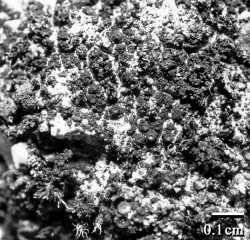
Nash, T.H., Ryan, B.D., Gries, C., Bungartz, F., (eds.) 2002. Lichen Flora of the Greater Sonoran Desert Region. Vol 1. Thallus: crustose, effuse, areolate areoles: irregular in outline, 0.25-1.5 (-2) mm wide, 0.2-0.5 (-1) mm thick, surface: black, warty to granulose, uneven, rarely smooth lower surface: attached to the substrate by rhizohyphae Apothecia: semi-immersed to sessile, zeorine, 1-3 per areole, up to 0.4 mm wide; disc: at first punctiform and depressed, later open and ± flat, reddish brown, with persisting, thin thalline margin; exciple: 25-50 (-75) µm wide, thick only in mature apothecia, hyaline or yellowish brown in apical parts, often visible as a light ring when mature apothecia are moistened, in juvenile apothecia remnants of conidiophores often present between hymenium and exciple (former pycnidial wall); epihymenium: faintly reddish brown; hymenium 125-200 µm high, hyaline, amyloid; paraphyses: very thin, indistinctly septate, sparingly branched and anastomosing; apical cells: slightly thickened (-3 µm) asci: 8-spored ascospores: simple, hyaline, broadly ellipsoid to globose, (7.5-) 10-12.5 (-15) x (5-) 7.5-10 µm; walls: thin Pycnidia: immersed, globose to broadly pyriform, 0.075-0.125 mm long, 0.075-0.1 mm in diam. conidia: cylindrical, 3 x 1 µm Spot tests: all negative Secondary metabolites: none detected. Substrate and ecology: on siliceous (granite or volcanic) or calcareous rocks, sometimes mixed with mosses over weathered rocks, inclined or horizontal surfaces in shaded or sheltered rock faces of boulders; mainly montane World distribution: North America, Europe, North Africa Sonoran distribution: central and southern Arizona, southern California; Baja California Sur. Notes: Very similar are species of Psorotichia, which have a thinner (<15 µm) proper exciple, that may even lack and a subhymenium that usually extends as a stipe deeper into the thallus. Also similar is Lemmopsis arnoldiana whis apparently is confined to limestone or caliche and which shows a characteristic yellowish-golden coloration in the entire exciple. Unlike Porocyphus, in Psorotichia and Lemmopsis the ascomata arise from a tangle of generative hyphae and the paraphyses are more robust. |








Powered by Symbiota