
Consortium of Lichen Herbaria
- building a Global Consortium of Bryophytes and Lichens as keystones of cryptobiotic communities -
- Home
- Search
- Images
- Species Checklists
- US States: O-Z >
- US National Parks
- Central America
- South America
- US National Parks
- Southern Subpolar Region
|
Trapelia coarctata (Sm.) Choisy
 |
|
|
Family: Trapeliaceae
[Biatora arridens (Nyl.) Walt. Watson, moreBiatora coarctata (Turner ex Sm.) Th. Fr., Biatora coarctata f. albomarginata (Hazsl.) Oxner, Biatora coarctata f. coarctata (Turner ex Sm.) Th. Fr., Biatora coarctata f. terrestris Flot., Biatora coarctata subsp. coarctata (Turner ex Sm.) Th. Fr., Biatora coarctata var. biatoriza (Vain.) Räsänen, Biatora coarctata var. coarctata (Turner ex Sm.) Th. Fr., Biatora coarctata var. petractis Norman, Biatora coarctata var. trapelia (Ach.) Räsänen, Biatora coarctata var. valamoënsis (Vain.) Räsänen, Gasparrinia coarctata (Turner) Tornab., Lecanactis arridens Nyl., Lecanora coarctata (Turner) Ach., Lecanora coarctata f. albomarginata (Hazsl.) Zahlbr., Lecanora coarctata f. coarctata (Turner) Ach., Lecanora coarctata f. cotaria Ach., Lecanora coarctata f. fulgiana Zahlbr., Lecanora coarctata f. ochrinactella (Vain.) Zahlbr., Lecanora coarctata f. sorediosa (B. de Lesd.) Zahlbr., Lecanora coarctata f. subfumigata (Nyl.) Zahlbr., Lecanora coarctata subsp. angelica Parrique, Lecanora coarctata subsp. coarctata (Turner) Ach., Lecanora coarctata var. argilliseda Dufour ex Schaer., Lecanora coarctata var. biatoriza (Vain.) Zahlbr., Lecanora coarctata var. coarctata (Turner) Ach., Lecanora coarctata var. exposita (Nyl.) Nyl., Lecanora coarctata var. expositella (Vain.) Zahlbr., Lecanora coarctata var. fossulans Stizenb., Lecanora coarctata var. listrata Ach., Lecanora coarctata var. prominula Schaer., Lecanora coarctata var. trapelia (Ach.) Zahlbr., Lecidea arridens Nyl., Lecidea coarctata (Smith) Nyl., Lecidea coarctata f. albomarginata (Hazsl.) Szatala, Lecidea coarctata f. coarctata (Turner) Nyl., Lecidea coarctata f. deliciosula Th. Fr., Lecidea coarctata f. depauperata Leight., Lecidea coarctata f. fulgiana (Chevall.) Zahlbr., Lecidea coarctata f. prominula (Schaer.) Szatala, Lecidea coarctata f. sorediosa B. de Lesd., Lecidea coarctata f. subfumigata Nyl. ex Zwackh, Lecidea coarctata f. terrula Hulting, Lecidea coarctata subsp. coarctata (Turner) Nyl., Lecidea coarctata subsp. dioritica Vain., Lecidea coarctata var. argilliseda (Dufour ex Schaer.) Arnold, Lecidea coarctata var. biatoriza Vain., Lecidea coarctata var. coarctata (Turner) Nyl., Lecidea coarctata var. dioritica (Vain.) Vain., Lecidea coarctata var. exposita Nyl., Lecidea coarctata var. expositella Vain., Lecidea coarctata var. lutosa Zahlbr., Lecidea coarctata var. ochrinactella Vain., Lecidea coarctata var. trapelia (Ach.) Vain., Lecidea fulgiana Chevall., Lichen coarctatus Turner, Parmelia coarctata (Turner) Ach., Parmelia coarctata var. coarctata (Turner) Ach., Patellaria coarctata (Turner) Wallr., Rinodina coarctata (Turner) Gray, Zeora coarctata (Turner ex Sm.) Flot., Zeora coarctata f. albomarginata Hazsl., Zeora coarctata f. coarctata (Turner ex Sm.) Flot., Zeora coarctata var. coarctata (Turner ex Sm.) Flot., Zeora coarctata var. variolosa Flot.]  Gary Perlmutter |
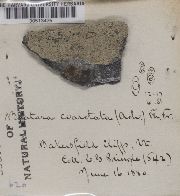
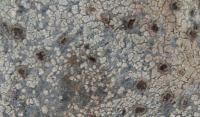
Nash, T.H., Ryan, B.D., Gries, C., Bungartz, F., (eds.) 2004. Lichen Flora of the Greater Sonoran Desert Region. Vol 2. Thallus: effuse and continuous to cracked or areolate, never distinctly effigurate at edge; prothallus: +present, white areoles: mostly contiguous but sometimes dispersed and +squamulose at margins, smooth to +rugose, thin, not marginally crenate to lobed surface: white to gray, green-white or pale brown, often tinged pink, K-, P- Apothecia: round, scattered; 0.2-0.8(-2) mm in diam. disc: rose-pink to red-brown or brown-black, +roughened, margin: thin, white, smooth to crenate, pseudothalline caused by its eruption through the thallus, part of which may remain adhering, +forming a halo-like rim, at least when young hymenium: hyaline below, hyaline to yellowish brown above, 90-140 µm tall; hypothecium: colorless ascospores: hyaline, simple, 14-25 x 7-13 µm Pycnidia: immersed conidia: filiform Spot tests: thallus K-, C+ reddish, KC+ reddish Secondary metabolites: thallus with gyrophoric acid chemosyndrome. Substrate and ecology: on siliceous rocks and stones, brickwork, occasionally on consolidated clay soil World distribution: cosmopolitan and widely distributed in temperate regions of both hemispheres Sonoran distribution: eastern Arizona and southern California Notes: Trapelia coarctata is characterized by a smooth thallus and pseudolecanorine apothecia. It is very variable. Immature apothecia may appear as scattered, starkly white, punctiform dots. |
       André Aptroot           Amanda Zinke : Field Museum of Natural History - Botany Department  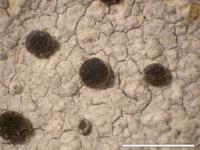 Bruce McCune        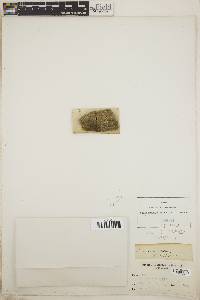 Amanda Zinke : Field Museum of Natural History - Botany Department           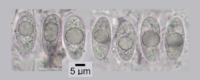 Bruce McCune               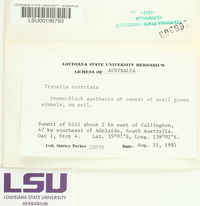      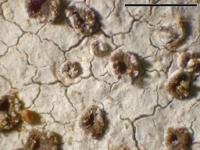 Bruce McCune    Amanda Zinke : Field Museum of Natural History - Botany Department  Amanda Zinke : Field Museum of Natural History - Botany Department             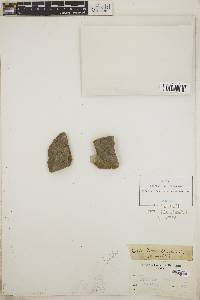 Amanda Zinke : Field Museum of Natural History - Botany Department   |
|


Powered by Symbiota