
- Home
- Search
- Images
- Species Checklists
- US States: O-Z >
- US National Parks
- Central America
- South America
- US National Parks
- Southern Subpolar Region
|
Parmotrema xanthinum (Müll. Arg.) Hale
 |
|
|
Family: Parmeliaceae
[Parmelia aberrans (Vain.) Abbayes, moreParmelia caperata var. madagascariacea Hue, Parmelia chrysantha Tuck., Parmelia madagascariacea (Hue) Abbayes, Parmelia nyasensis C.W. Dodge, Parmelia perlata var. xanthina (Müll. Arg.) Stizenb., Parmelia proboscidea var. xanthina Müll. Arg., Parmelia xanthina (Müll. Arg.) Vain., Parmelia xanthina f. aberrans Vain., Parmelia xanthina f. isidiosa Müll. Arg., Parmelia xanthina f. xanthina (Müll. Arg.) Vain., Parmelia xanthina var. xanthina (Müll. Arg.) Vain., Parmotrema aberrans (Vain.) des Abbayes, Parmotrema madagascariaceum (Hue) Hale, Parmotrema nyasense (C.W. Dodge) R.S. Egan nom. illegit.]  Frank Bungartz |
MycoBank no. 833909 Type: Malawi [State or Province, and exact locality unknown]. Vernay Nyasaland Expedition of 1946, Nchisis Mt., 1400 m, on dry rocks in Brachystegia-woodland, 24-Jul-1946, Brass, L.J. 16922 (FH – holotype, NY – isotype, fide Egan et al. 2016). Description. Thallus corticolous, rarely saxicolous; upper surface pale greenish yellow, dull to ± shiny, emaculate, typically not cracked; abundantly isidiate; isidia mostly marginal and laminal, cylindrical to dactyliform (i.e., ± constricted at their base, tapering at the apex), brown to blackened at their tip and frequently ciliate; lobes small to moderate-sized, 2–6 mm wide, rotund, axils forming loops, margins abundantly ciliate; cilia short and slender, 0.3–1.5 mm long, black, mostly simple, very rarely branched; lower surface with a deep brown, erhizinate, ~ 1–2 mm wide margin, soon blackened and densely rhizinate towards the center; rhizines long, slender, black, mostly simple, very rarely sparsely branched; medulla white. Apothecia and pycnidia not observed among the Galapagos specimens. Chemistry. Cortex with usnic acid [P–, K–, KC± dirty yellowish brown, C–, UV–]; medulla with gyrophoric acid, and an unknown terpenoid [P–, K–, C+/KC+ pale pink (C and KC reactions are evanescent and must be examined under continuous observation); UV–]. Ecology and distribution. Neotropics from Mexico to Paraguay, Africa, Asia (Hale 1965; Nash & Elix 2002; Divakar & Upreti 2005; Marcelli & Canêz 2008; Egan et al. 2016). Previously reported from the Galapagos as P. aberrans, P. neotropicum, P. flavescens and/or P. xanthinum (see doubtful and incorrect reports). A rare species, found in the transition zone of Pinzón and Volcán Darwin, and the high altitude transition zone of Volcán Darwin, on exposed rock and trunk of the endemic cactus Jasminocereus thouarsii. Notes. A corticolous, or rarely saxicolous, isidiate species with a strikingly pale yellow thallus and conspicuous, slender marginal cilia which are dark-tipped and apically often ciliate. In Galapagos this species has previously been confused with the superficially similar P. xanthinum (Müll. Arg.) Hale, a species lacking gyrophoric acid and distinguished also by much broader lobes and eciliate isidia. A detailed discussion can be found in Egan et al. (2016). Nash, T.H., Ryan, B.D., Gries, C., Bungartz, F., (eds.) 2002. Lichen Flora of the Greater Sonoran Desert Region. Vol 1. Thallus: foliose, loosely adnate, 3-20 cm in diam., lobate lobes: subirregular, elongate, slightly imbricate, plane, separate, 8-12 mm wide; apices: rotund, becoming crenate and dissected with age, ciliate; cilia: up to 2.5 mm long upper surface: yellow green, smooth, dull, epruinose, emaculate, finely reticulately cracked with age isidia: simple to coralloid branched, often apically ciliate, common, initially laminal but becoming submarginal to marginal with age; soredia and pustulae: absent medulla: pale orange yellow with continuous algal layer lower surface: black with brown naked zone peripherally, centrally rhizinate; rhizines: simple Apothecia: not seen Pycnidia: not seen Spot tests: upper cortex K+ yellow, C-, KC-, P-; medulla K-, C-, KC+ red or KC-, P- Secondary metabolites: upper cortex with usnic acid (major) atranorin (trace); medulla with protolichesterinic acid (major). Substrate and ecology: trees or rocks in open habitats World distribution: pantropical and southern Africa Sonoran distribution: oak and pine forests of the Sierra Madre Occidental in Sinaloa. Nash, T.H., Ryan, B.D., Gries, C., Bungartz, F., (eds.) 2002. Lichen Flora of the Greater Sonoran Desert Region. Vol 1. Thallus: loosely adnate, foliose, 3-15 cm in diam., lobate lobes: subirregular, elongate, slightly imbricate, plane, separate, 10-15 mm wide; apices: rotund, becoming crenate and dissected with age, ciliate; cilia: up to 3.0 mm long upper surface: yellow green with some blackened areas, smooth, dull to shiny, epruinose, emaculate, finely reticulately cracked with age isidia: simple to coralloid branched, sometimes apically ciliate, common, laminal; soredia and pustulae: absent medulla: pale orange yellow with continuous algal layer lower surface: black with brown naked zone peripherally, centrally rhizinate; rhizines: simple Apothecia: rare, substipitate, up to 4 mm in diam.; margin: sparsely sorediate; disc: brown, imperforate ascospores: broadly ellipsoid, 10-16 x 7-10 µm Pycnidia: not seen Spot tests: upper cortex K+ yellow, C-, KC-, P-; medulla K-, C+ red, KC+ red, P- Secondary metabolites: upper cortex with usnic acid (major), atranorin and chloroatranorin (trace); medulla with gyrophoric acid (major). Substrate and ecology: usually on trees in open habitats, rarely on rocks World distribution: neotropics from Mexico to Paraguay Sonoran distribution: on pines in the pine-oak forests of the Sierra Madre Occidental of Sinaloa. |
 Frank Bungartz  Frank Bungartz  Frank Bungartz     Stephen Sharnoff  Stephen Sharnoff  Stephen Sharnoff  Stephen Sharnoff 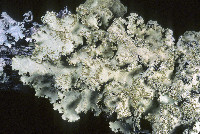 Stephen Sharnoff 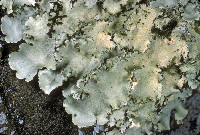 Stephen Sharnoff  Troy McMullin  Gary Perlmutter 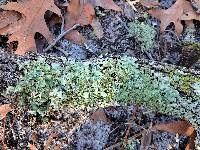 Gary Perlmutter                               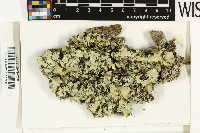                     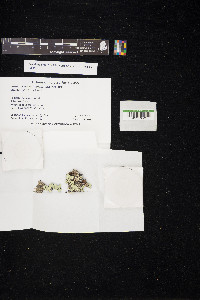  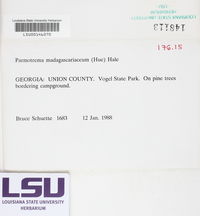 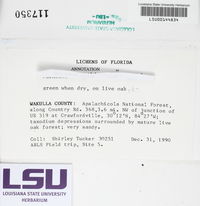  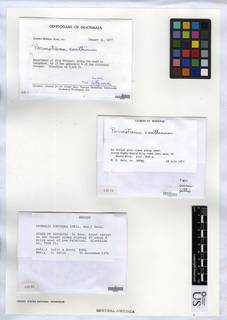              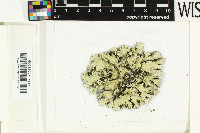  |
|


